AI adoption is a change management challenge, not simply a technology rollout
Read Time: 6 mins
Many organisations are beginning their AI journey by giving employees access to tools such as ChatGPT, Claude and Microsoft Copilot, along with some introductory training. That is a useful starting point, but access and training alone don’t drive adoption. An effective AI adoption and change management approach also considers how people feel about the technology, how it connects to the work they already do and what they need to use it safely, confidently and purposefully.
People also need to understand why the organisation is introducing AI, how it relates to their work, and where it can create genuine value. They need clear guardrails, opportunities to experiment and a practical way to share what they learn.
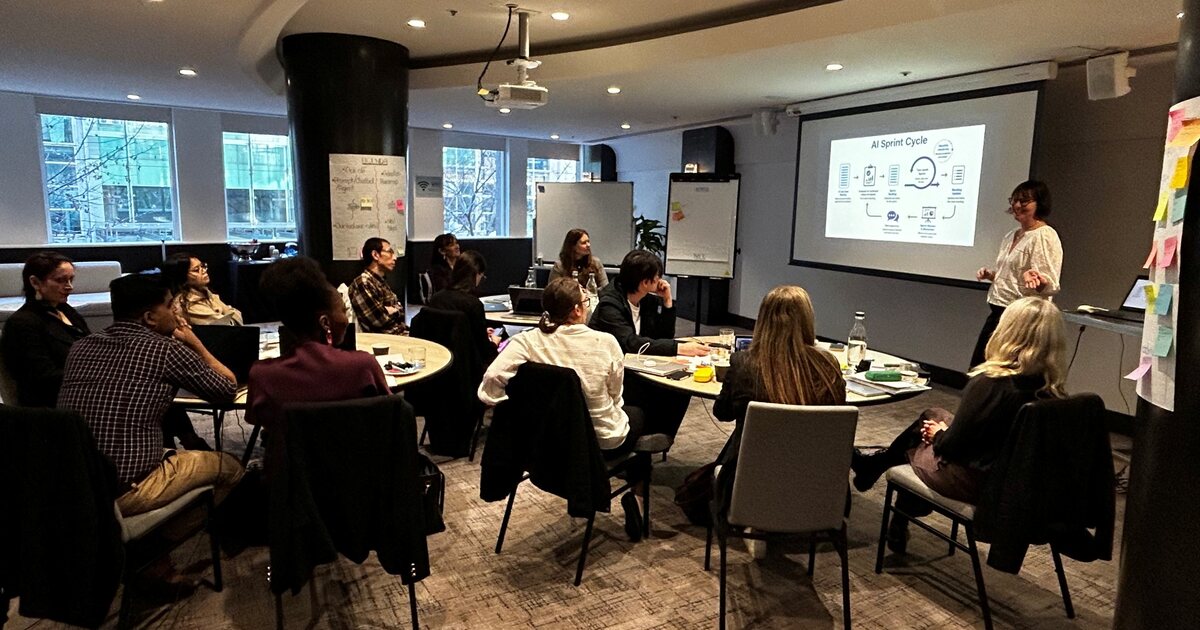
I recently facilitated an AI Adoption and Change Management Workshop with Hello Sunday Morning, an Australian not-for-profit organisation supporting people to change their relationship with alcohol. The experience reinforced something I have seen repeatedly. Adopting AI presents many of the same challenges as any other organisational change.
People respond differently to the technology. Some are enthusiastic and already experimenting. Others are cautious, sceptical or concerned about issues such as confidentiality, accuracy, professional judgement and the effect AI may have on their role.
The technology matters, but successful adoption depends just as much on how people are engaged, supported and involved in the process.
For small- to medium-sized businesses and not-for-profits, this does not necessarily require a large transformation program or a full-time change manager. Change management can be built into how the organisation introduces, tests, and embeds AI.
Begin with the business, not the technology
It is easy to become distracted by everything AI can do. New tools and features appear constantly, and some are genuinely exciting.
But the most useful starting question is not, “What could we do with AI?” It is, “What is the organisation trying to achieve, and where is work currently getting in the way?”
The approach I use begins with four connected steps:
Business strategy → Business challenges → AI use cases → AI adoption plan
Teams first consider their organisational priorities and the value they want to create. They then identify the work that feels slow, repetitive, difficult or frustrating.
This might include:
- administrative tasks that take too long
- information stored across different systems
- repeated work or duplication
- difficulty finding reliable organisational information
- inconsistent processes or communication
- specialist knowledge that is not always available
- work that draws people away from higher-value activities
Only then do we ask whether AI could help.
Not every organisational problem is an AI problem. Starting with the business need helps teams avoid creating tools simply because they can. It also helps smaller organisations focus their limited time and resources on the opportunities most likely to make a difference.
Create psychological safety around AI
People bring a wide range of feelings to AI.
Fear and uncertainty can lead people to avoid new tools altogether. They may also experiment privately because they are unsure what is permitted or feel uncomfortable admitting what they do not know.
Neither response supports safe or consistent adoption.
This is why I begin workshops by asking people how they feel about AI and how confident they currently feel using it. It gives the team permission to discuss both the opportunities and the concerns.
Those conversations matter. People may be worried about making mistakes, inadvertently sharing confidential information, relying too heavily on an inaccurate response or being judged because they are less confident than their colleagues.
Acknowledging these concerns reduces some of the unknowns. It also helps leaders understand what their people need if they are going to approach the technology with curiosity rather than avoidance.
Psychological safety does not mean removing accountability or pretending there are no risks. It means creating an environment in which people can ask questions, admit uncertainty, test ideas and learn from one another.
Develop the guardrails together
Responsible AI adoption requires clear guardrails, but a policy sitting in a folder is not enough.
Teams need to understand how the guardrails apply to their work. They also need to discuss where AI can be used independently, where human review is required, where AI should play only a supporting role and where a task or decision should remain entirely human.
This is particularly important in organisations working with sensitive information, vulnerable communities or decisions requiring professional judgement.
In the workshops, participants explored risks such as:
- inaccurate or fabricated information
- privacy and data leakage
- bias
- over-reliance on AI
- intellectual property
- inappropriate use of sensitive information
- unclear accountability
- content that does not reflect the organisation’s voice or values
They then helped identify practical ways of managing those risks.
Involving employees in these discussions builds understanding and ownership. The guardrails become shared ways of working rather than rules imposed from elsewhere.
The conversation also becomes more nuanced. The question is no longer simply, “Can we use AI?” It becomes, “How can we use it responsibly in this particular situation?”
Turn workplace challenges into useful AI use cases
Once the business challenges are clear, teams can begin turning suitable problems into AI use cases.
I use a simple formula:
Person + Task + AI support + Business benefit
For example:
We use ChatGPT to draft meeting summaries so actions can be distributed sooner and administration time is reduced.
A clearly written use case identifies who is involved, what they are trying to do, how AI will support the task and the value it is expected to create.
That value might include:
- saving time
- improving quality or consistency
- strengthening communication
- reducing repetitive work
- making knowledge easier to access
- supporting better decisions
- creating a better experience for employees, clients or stakeholders
This is an important distinction. AI value is not only about efficiency. It can also improve engagement or enable an organisation to deliver a service in a new way.
Prioritise, rather than trying to do everything
Most teams can quickly generate more AI ideas than they have the capacity to develop.
A shared backlog gives the organisation somewhere to capture those ideas. The use cases can then be assessed according to their likely business value and the time or effort required to build them.
I group them into four broad categories:
- Quick wins: relatively fast to build and able to create some immediate value
- Momentum makers: fast to build with the potential to create significant value
- Strategic bets: potentially valuable but requiring more time, capability or investment
- Dead ends: time-consuming ideas that are unlikely to create enough value
Starting with a small number of achievable use cases helps the team test its adoption process and build confidence. Momentum makers can then demonstrate more substantial value and encourage broader participation.
Strategic opportunities still matter, but they are easier to pursue once the organisation has developed greater experience, governance and capability.
Build a skateboard before the sports car
One of the biggest barriers to AI adoption is the expectation that the first version of a shared AI tool or process should be the finished product.
I use the idea of building a skateboard before building a sports car.
The skateboard is the minimum viable product, or MVP. It has enough value for people to use and test, but it is not expected to include every possible feature.
The team builds it, tries it in real work, gathers feedback and decides what to improve next. The next version might be a bicycle, a motorbike or something the organisation had not imagined at the beginning.
This is why an agile approach is so well suited to AI adoption. The technology continues to change, and organisations will not know everything at the outset.
Short sprint cycles allow teams to:
- select a priority use case from the backlog
- build a useful first version
- test it in a controlled way
- gather feedback
- measure whether it is creating value
- improve it, scale it or decide not to continue
Leaders play an important role here. They need to understand that iteration is the method, not evidence that the initial work has failed.
When leaders expect a sports car and the team delivers a skateboard, disappointment is almost inevitable. When everyone understands the purpose of an MVP, the organisation can recognise progress, learn from the first version and make better decisions about what to build next.
Turn individual learning into organisational capability
Many employees are already finding useful ways to work with AI. The risk is that this knowledge remains with individuals.
A sprint review or regular show-and-tell gives people an opportunity to demonstrate what they have built, explain how they created it and share what they learned.
This is not an optional extra. It is the point at which individual experimentation starts to become organisational capability.
A central AI use case register can also help the organisation keep track of:
- what has been created
- who owns it
- the business problem it addresses
- its current stage of development
- any relevant risks or governance requirements
- feedback and lessons learned
- the benefits it has achieved
The process should remain simple enough for people to use. Smaller organisations do not need to recreate the governance structures of a large corporation. In fact, over-engineering the process can make it harder to build momentum.
They do, however, need clear ownership, a way to make responsible decisions and a central place to share what works.
AI adoption is an ongoing capability journey
AI adoption is not a one-off workshop or technology rollout. It is an ongoing process of learning, testing, sharing and improving.
Successful adoption begins with people: how they feel, what they need, the problems they are trying to solve and whether they feel safe enough to experiment.
For small- to medium-sized businesses and not-for-profits, building change management into AI adoption from the outset provides a practical alternative to a large transformation program.
It creates a structured way to connect AI with business priorities, involve employees in decisions, manage risk, test valuable ideas and build shared capability over time.
The goal is not to implement as much AI as possible.
It is to help people use AI confidently, responsibly and purposefully to improve the work that matters.
You can learn more about the Skill and Will AI Adoption Program.

